
Surge Protection in South Loop, Chicago
The South Loop sits adjacent to Chicago's central business district, and its ComEd service infrastructure reflects downtown-level load density. The underground feeder cables and aerial bundles serving the neighborhood's residential towers and ground-floor commercial spaces carry enormous loads and experience switching transients whenever substations reroute power around faults or handle load balancing across the grid. Underground distribution doesn't eliminate surge risk — it reduces lightning-direct-strike exposure while retaining all the transient risk from grid switching, cable aging, and fault isolation events.
South Loop high-rise condos present a specific vulnerability pattern. Builder-grade unit sub-panels in glass-and-steel towers from the 2000s and 2010s were designed for basic appliance loads, not the dense electronics of a modern work-from-home setup. A homeowner who has added a dedicated home office circuit, a wine refrigerator, and a Level 2 EV charger circuit has used most of the available capacity — and none of it is protected by surge clamping unless an SPD was installed at the unit panel.
Printer's Row lofts in the converted printing warehouse buildings south of the Loop — along Dearborn and Plymouth Court — have a different electrical heritage. Some of these buildings carry oversized industrial feeders from their print-shop days, with quirky service configurations that weren't designed with residential electronics in mind. The transient environment in a building with a mixed industrial-residential legacy is harder to predict, making whole-unit surge protection particularly important.
The Prairie Avenue Historic District at the south end of the South Loop includes some of Chicago's oldest surviving mansions. These buildings are being renovated, and their new electrical service — once code-required SPDs are included — provides protection for the premium electronics and smart-home systems going into restored interiors.
Our Surge Protection Process in South Loop
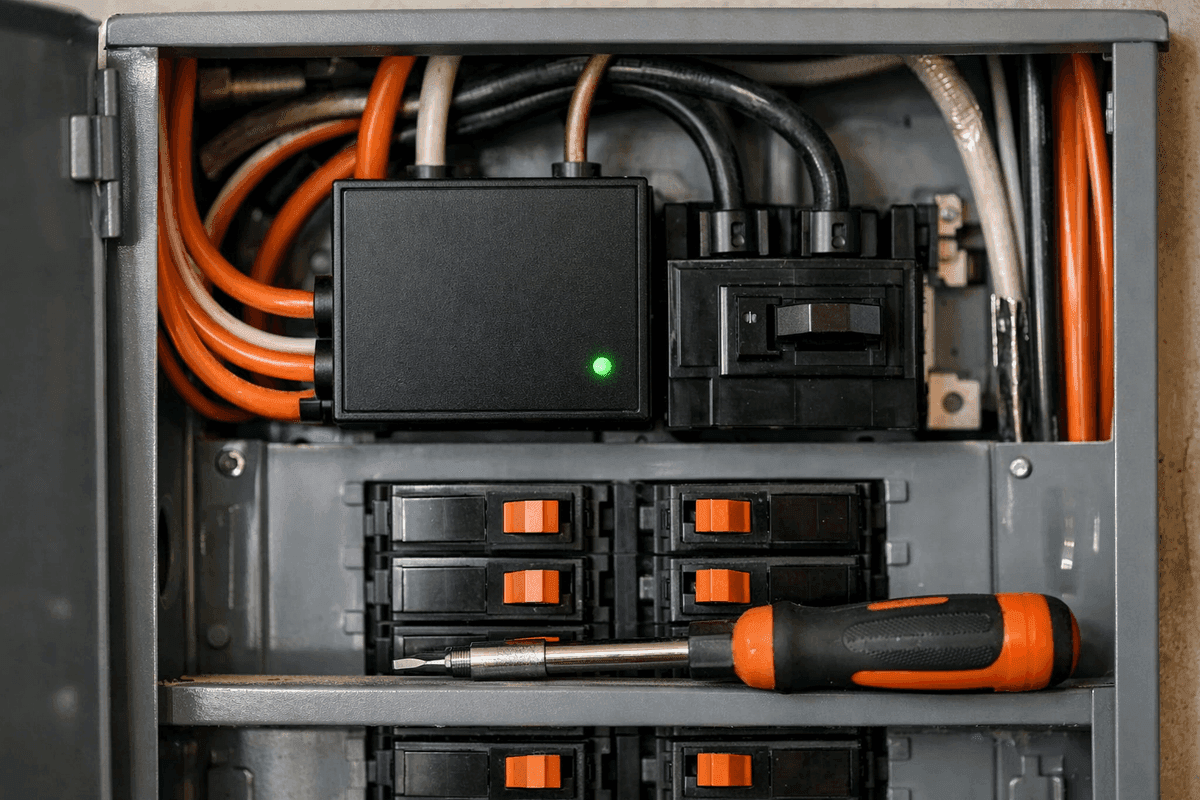
South Loop condo installations begin with an HOA or property management notification when required — most buildings require proof of license and a permit notification before interior electrical work. We walk the unit's panel (typically a 100A–125A sub-panel in a utility closet or mechanical niche), confirm available breaker space, verify grounding, and install a Type 2 SPD compatible with the panel manufacturer.
The installation takes one to two hours and requires a brief planned power interruption. We coordinate with the resident for a convenient time and complete the installation without requiring building-management involvement unless the scope extends to common infrastructure.
For building managers or HOAs that want building-level surge protection at the main service entrance, we assess the building's main panel in the basement mechanical room and provide a proposal for installation at that level. Building-level protection is the most efficient approach for protecting all units from external transients simultaneously.
Common Surge Risks in South Loop
- Downtown-adjacent underground distribution switching — ComEd's underground feeder network serving downtown-adjacent neighborhoods generates switching transients from substation load balancing and fault isolation
- High-rise shared building services — In buildings where multiple units share a common service entrance, a transient on the main feeder reaches all unit sub-panels before outlet-level strips can respond
- Printer's Row mixed industrial-residential buildings — Older converted buildings with legacy industrial electrical configurations have unpredictable transient environments
- Dense home-office electronics in modern condos — South Loop residents have high densities of home office computing and networking equipment with significant replacement value
- Ground-floor commercial load cycling — Restaurant and retail compressors and motors in South Loop mixed-use buildings generate internal transients that can reach upper-floor residential panels through shared building wiring
Why South Loop Residents Choose E&P Electric
South Loop condo owners expect contractors who understand the building-management environment — licensed credentials, permit documentation, HOA coordination, and clean work that doesn't require building maintenance to clean up afterward. We've done in-unit electrical work in South Loop high-rises from Museum Campus to the Printer's Row area, and we know how to coordinate with building engineers, produce the documentation associations require, and complete work on the unit owner's schedule.
For Prairie Avenue Historic District properties, we understand the landmark-district context and the preservation priorities that come with those addresses. All SPD work is done at the interior panel — no exterior modifications — so landmark review is never triggered by surge protection installation.
Get a Free Estimate Today
Serving Chicago and Chicagoland. Licensed and insured.