
Recessed Lighting in West Town, Chicago
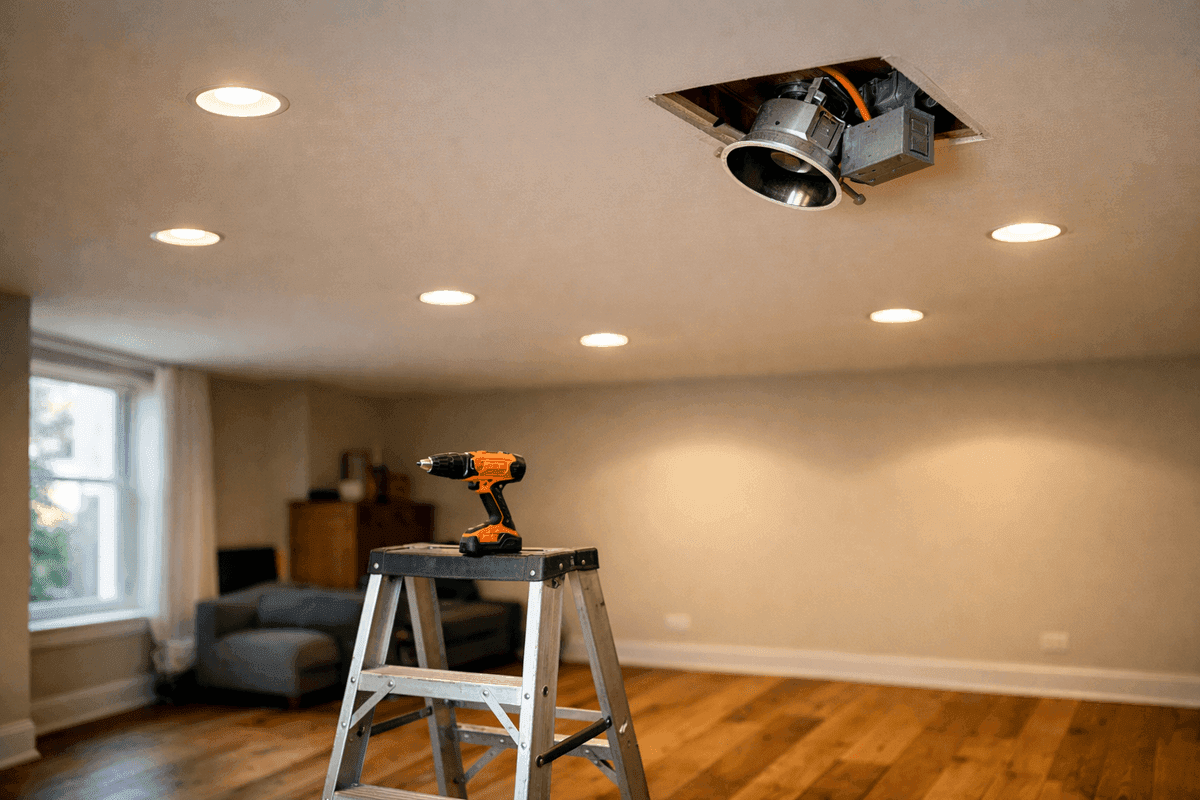
The East Village workers' cottage is the neighborhood's most distinctive housing type — small, low-ceilinged (7.5 to 8 feet is common), and built with balloon-frame construction that makes cable routing fast. The original ceiling box sits at the center of each room, fed by cloth-insulated branch circuits in most pre-renovation examples. Adding recessed lighting to a remodeled East Village cottage transforms the scale of the space: a living room that felt cramped with a single overhead pendant opens up visually with six evenly-spaced cans on a dimmer, particularly when warm-white 2700K LEDs are used to match the vintage character of the building.
Two-flat units in Noble Square and Smith Park are a slightly different scale — taller ceilings (8.5 to 9 feet), longer rooms, and more floor area to light. Owner-occupants in these buildings often renovate their own units while maintaining rental income from the other, and recessed lighting is a standard part of those unit-level upgrades.
New-construction single-family homes in West Town — the teardown-rebuild projects on the neighborhood's 25-foot lots — get full recessed lighting rough-in during framing as a standard offering. The first walk-through with the GC establishes fixture layouts room by room; we nail can housings to joists, wire everything before drywall goes up, and return for trim-out after paint.
Chicago Avenue and Division Street restaurants, bars, and retailers are a commercial recessed lighting market. A new restaurant build-out on Chicago Avenue typically needs a mix of high-output service-area fixtures and warm-dim bar cans, all on commercial-rated dimmable circuits.
Our Recessed Lighting Process in West Town
For East Village cottage retrofits with finished plaster ceilings, wafer-style LED fixtures are the right tool. The 7.5- to 8-foot ceiling height calls for fixture sizing that balances output against glare at close range — we typically specify 4-inch aperture fixtures at 600 to 750 lumens, which delivers good general illumination without the hot-spot glare that higher-output fixtures can create at low mounting heights.
Balloon-frame cottage construction means cable can drop vertically through wall bays from the attic or basement. West Town cottages almost always have accessible basements with exposed framing — circuit routing from the panel to the first ceiling junction is clean work. From there, cable runs through the attic or is fished through walls depending on the building's specific framing.
For new-construction rough-in, timing is everything. We show up at the framing stage, plan with the GC on fixture placement, nail housings, and pull cable. Recessed lighting rough-in in a new-construction West Town single-family of 2,000 to 3,000 square feet typically takes one to two days. Trim-out after drywall and paint is another half-day.
Commercial build-outs on Chicago Avenue and Division get commercial permits. We specify commercial-rated recessed fixtures, calculate circuit loading for the space's occupancy type, and coordinate with the health department and building inspector on the inspection sequence.
Common Recessed Lighting Considerations in West Town
- East Village plaster ceilings at 7.5 to 8 feet — Lower ceiling heights call for 4-inch fixtures with moderate lumen output (600-750 lumens) to avoid glare. Wafer-style LEDs clip to the plaster face with a small hole.
- Balloon-frame construction — Standard in pre-1900 East Village cottages. Cable drops cleanly through wall bays; attic access is often available for top-floor circuit runs.
- New-construction timing — Teardown-rebuild projects get recessed rough-in at framing. Fixture layout coordination with the GC and architect happens before rough-in day.
- Two-flat unit upgrades — Noble Square and Smith Park two-flats have 8.5- to 9-foot ceilings and longer rooms. Fixture spacing and lumen output are adjusted for the larger scale.
- Chicago Avenue commercial — Restaurant and retail recessed lighting on the main commercial corridors requires commercial occupancy permits, commercial-rated fixtures, and Chicago electrical permits.
Why West Town Residents Choose E&P Electric
West Town has one of the highest rates of residential renovation activity in Chicago, and homeowners here know the difference between a contractor who does good work and one who doesn't. E&P Electric brings finished-ceiling expertise to East Village cottages, new-construction delivery reliability to teardown-rebuild clients, and commercial build-out experience to Chicago Avenue businesses. Our owner holds a Chicago Supervising Electrician License, permits are pulled for every project, and the result is always clean and fully inspected.
We also specialize in the narrow-lot West Town context — service placement on alley elevations, circuit routing in tight balloon-frame wall bays, and coordinating with GCs on new-build schedules that have to hit opening dates.
Get a Free Estimate Today
Serving Chicago and Chicagoland. Licensed and insured.