
Recessed Lighting in Chatham, Chicago
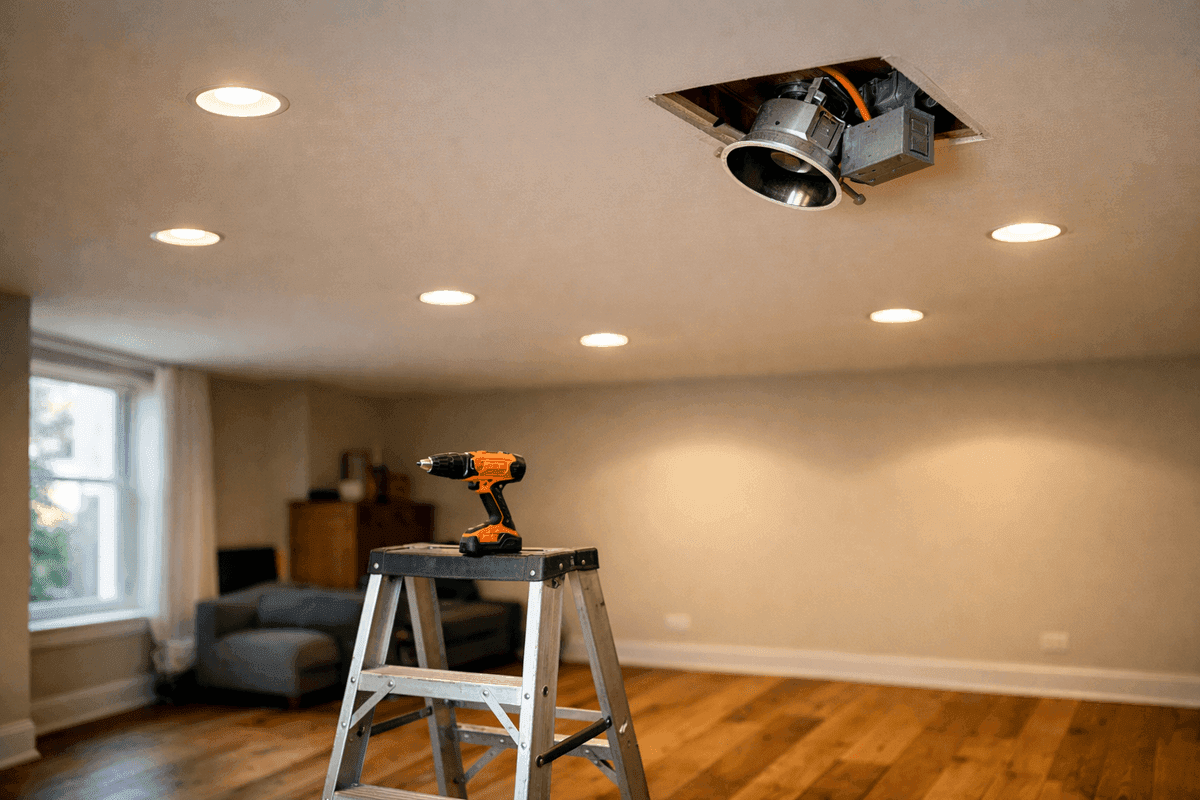
The classic Chatham bungalow has front living and dining rooms with 8- to 9-foot plaster ceilings, limited natural light from the front and side windows, and original ceiling outlets that were designed for a single globe fixture. Adding six to eight recessed LED cans per room brings even, adjustable illumination that makes the original hardwood floors, plaster cornices, and built-in cabinetry look their best. A warm-dim LED at 2700K fading to 2200K on a dimmer replicates the incandescent feel that Chatham homeowners grew up with, without the energy cost.
Chatham bungalows also have the blessing of accessible basements. The full Chicago basement — 7 feet of headroom, exposed framing, and an accessible panel — makes new circuit routing clean. We pull new circuits from the panel box, run through the basement, and fish up through interior walls to the ceiling junction. In most Chatham bungalows, a kitchen or living-room lighting project runs one to two days.
The Chicago bungalow's characteristic art glass transoms and ornamental woodwork also mean homeowners want lighting that accents those features rather than competing with them. We position cans away from windows and transoms, use wall-wash trims for built-in bookcase walls, and specify adjustable-beam fixtures for accent work where the architecture calls for it.
Our Recessed Lighting Process in Chatham
The first step is a ceiling assessment. Chatham bungalows built in the 1920s-1940s have plaster-and-lath ceilings on the first floor, often with a thin 1970s drywall skim coat applied during a prior renovation. Both surfaces work with wafer-style LED fixtures — the fixture requires only a 3- to 4-inch hole, clips to the ceiling face, and leaves the surrounding plaster intact. We use a hole saw sized to the fixture, keep a drop cloth under each cut, and HEPA-vacuum plaster dust immediately.
Next we plan the circuit. A typical Chatham living-room project of 6 to 8 LED fixtures draws well under 100 watts total, so a dedicated 15A circuit shared with the dining room is adequate. We check the panel for available slots before committing to the circuit plan and adjust if needed. Dimmer compatibility is confirmed before installation: LED drivers and ELV dimmers must be matched to avoid flicker.
Insulation is a constant consideration. Many Chatham bungalow attics received blown-in insulation during the 1970s-80s energy-efficiency programs. IC-AT (Insulation Contact, Airtight) fixtures are always specified in these ceilings. They prevent heat build-up, maintain the attic insulation R-value, and keep conditioned air from escaping through fixture gaps.
Common Recessed Lighting Considerations in Chatham
- Plaster-and-lath first floors — Standard in Chatham's 1920s-1940s bungalows. Wafer-style LEDs require a 3- to 4-inch hole and cause minimal plaster disruption.
- Blown-in attic insulation — Common from 1970s weatherization programs. IC-AT fixtures are always required and always specified.
- Art glass and built-in woodwork — Chatham bungalows often have original art glass transoms and built-in cabinetry. Layout planning accounts for these features so lighting enhances rather than competes with them.
- Existing circuit capacity — Chatham homes that have had partial electrical updates may have 100A service with limited panel capacity. If a new lighting circuit isn't feasible without a panel upgrade, we discuss options clearly.
- Second-floor access — Bungalow second floors (the half-story under the hip roof) sometimes have sloped drywall ceilings with limited attic clearance. We use sloped-ceiling fixtures or wafer LEDs in these spaces rather than traditional cans.
Why Chatham Residents Choose E&P Electric
Chatham homeowners are careful stewards of their homes — they want a contractor who respects their property and their investment. E&P Electric brings drop cloths, HEPA vacuums, and finished-ceiling experience to every Chatham project. Our owner holds a Chicago Supervising Electrician License and we pull the electrical permit for every new circuit. Homeowners get a closed permit document at project end — useful for insurance, refinancing, and eventual resale.
We also understand the Chatham pace. Long-term owners often want to add lighting in the living room this fall, the kitchen next spring, and tackle the basement another time. We structure phased quotes and keep permits open across phases when code allows it, so you never have to pay full project-coordination costs twice.
Get a Free Estimate Today
Serving Chicago and Chicagoland. Licensed and insured.