
New Construction Wiring in Lincoln Park, Chicago
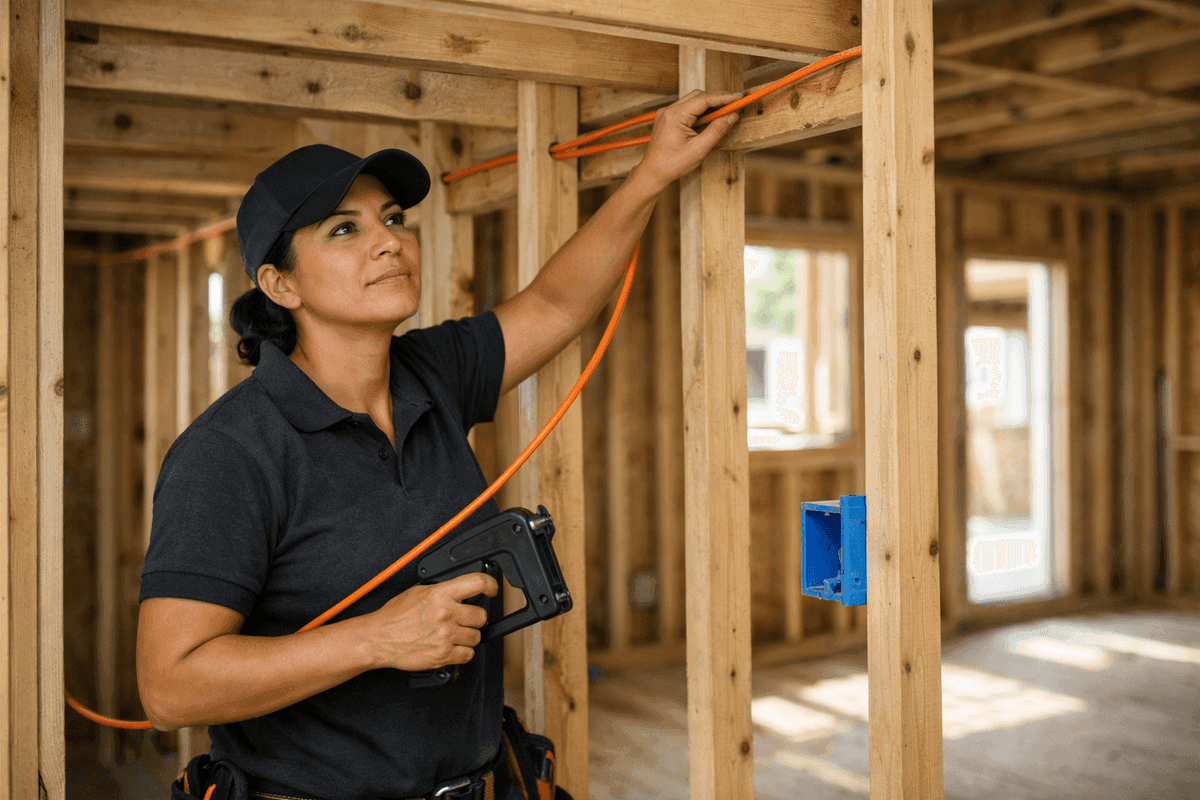
Lincoln Park's premium real estate market has driven a generation of teardown-rebuild construction. Where a deteriorated Victorian or coach house once stood, a four-story single-family with a finished basement, rooftop deck, and attached garage now rises. These homes aren't modest — they carry induction ranges, EV charging in the attached garage, whole-home audio, Lutron lighting control, radiant floor heat, and central air across multiple floors. Getting the electrical system right from the design phase means those features work seamlessly from day one.
The neighborhood also has a significant gut-rehab market. Restored Victorians near Oz Park and DePaul University's Fullerton campus are being stripped to the studs and rebuilt with modern mechanical and electrical systems behind original plaster medallions and intact wood trim. This is a different challenge than a new build on an empty lot — the electrician must work around the structural engineer's plan to preserve original masonry and framing while installing a completely new electrical system behind it all.
Chicago's electrical code adds an important layer. Within city limits, residential new construction requires metallic wiring methods — EMT conduit, flexible metal conduit (FMC), or MC cable. Standard NM-B cable (Romex) is not permitted. Every panel, sub-panel, and junction box must be steel. Lincoln Park builders who have worked in the suburbs are sometimes surprised by this requirement. We plan it into every bid so there are no rough-in inspection surprises.
Our New Construction Wiring Process in Lincoln Park
Our Lincoln Park new construction engagements start at the design phase. We review the architectural set, confirm service entrance location and capacity, check load calculations for EV charging and HVAC, and flag any code issues before the plans go to the Chicago Department of Buildings. On large infill projects between Fullerton and Armitage, we often recommend 400-amp service from the outset — the future flexibility to add a generator, a second EV charger, or an expanded HVAC system is worth the modest upfront cost difference.
During rough-in, we install all service entrance conduit, the main panel, home runs, branch circuits, and boxes. Lincoln Park homes with detached coach houses or garage apartments require a separate feeder and sub-panel for the accessory structure — a scope we plan and permit separately so each dwelling unit can be independently metered with ComEd if needed. For homes in the Lincoln Park Landmark District on streets like Geneva Terrace and Belden, we coordinate meter placement to avoid any exterior changes that require Landmarks Commission review.
Trim-out comes near the end of the project when the drywall, millwork, and cabinet installation are substantially complete. We install outlets, switches, cover plates, light fixtures, and make final equipment connections. On a high-end Lincoln Park build, this phase can include programming Lutron circuits, commissioning the EV charger, and testing whole-home surge protection before the GC hands over keys.
Common New Construction Electrical Needs in Lincoln Park
- Teardown single-family homes — 200-amp or 400-amp service from the ground up on narrow infill lots between Fullerton and North Avenue; smart-home and EV provisions standard in the market
- Gut rehab Victorians — New electrical system installed during full demo; service upgrade from original 60-amp fuse service to modern 200-amp or 400-amp breaker panel while preserving original finishes
- Coach house and ADU conversions — Separate feeder, sub-panel, and independent ComEd metering for accessory dwelling units; common on streets like Cleveland, Howe, and Orchard
- Luxury new builds with smart home — Lutron homeworks, structured cabling (Cat6 and speaker wire), centralized AV rack prewire, and dedicated circuit mapping during rough-in
- EV charger provisions — Dedicated 60-amp feed to the garage rough-in for Level 2 charging; for attached garages, home run directly to the main panel; for detached garages, either sub-panel feed or a conduit stub with pull string
- Rooftop and outdoor living circuits — Rooftop deck lighting and receptacles on fully protected GFI circuits, rated for wet location; popular on recent new construction south of Armitage
Why Lincoln Park Builders Choose E&P Electric
We've been the calling card for Lincoln Park architects, general contractors, and homeowners for over three decades. Our supervising electrician license covers the full permit and inspection chain — design, permit submission through the Chicago Department of Buildings, rough-in inspection, final inspection, and ComEd service coordination — without subcontracting any phase. On a Lincoln Park project, that matters because the build timeline is tight and there's no room for a disconnect between the company that pulled the permit and the company that actually did the work.
Lincoln Park's high-end residential market means the finish quality on trim-out has to match the rest of the project. We use quality devices throughout — Legrand, Leviton commercial-grade, or Lutron as specified by the designer. We coordinate with the cabinet installer on cabinet-integrated lighting, with the AV integrator on low-voltage prewire, and with the landscape architect on outdoor circuit locations before the mason lays the paver walk.
We also understand the landmark and permit realities unique to Lincoln Park. Buildings in the Lincoln Park Landmark District on streets like Belden, Fullerton Parkway, and Geneva Terrace may require Landmarks Commission review for exterior meter placement or visible conduit on street-facing elevations. We check the Chicago Historic Resources Survey before scoping any exterior work and design installations to stay on the alley side or interior wherever possible.
Get a Free Estimate Today
Serving Chicago and Chicagoland. Licensed and insured.