
Generator Installation in West Loop, Chicago
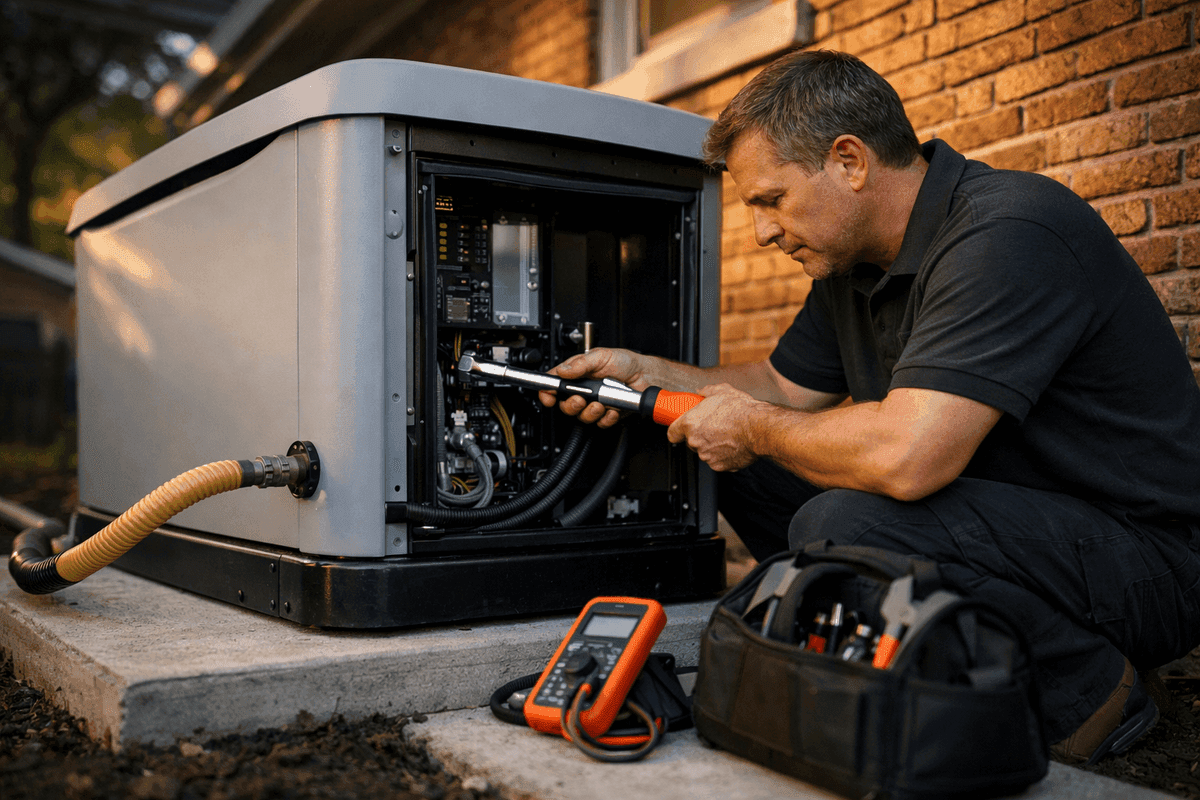
Fulton Market and Randolph Street are among the most power-dense commercial corridors in the city. A full-service restaurant in a converted packinghouse building on Fulton draws 400A of three-phase service just for the kitchen — walk-in coolers, range hoods, dishwashers, and prep equipment running simultaneously. When ComEd's underground service in this corridor goes down during a heavy rain event or infrastructure fault, the financial losses are immediate and significant.
Walk-in coolers are the most expensive casualty. A 400 sq ft walk-in stocked for a busy weekend service contains $8,000–$20,000 worth of protein and produce. Illinois food safety regulations require discarding food that has been above 41°F for four hours. Without a generator, a six-hour overnight outage at Randolph & Green means everything in the walk-in gets thrown out.
Residential West Loop — the luxury loft buildings along Fulton, Morgan, and Lake Street — has its own generator case. High-end loft conversions in the Fulton Market historic district are now selling for $1.5 to $3 million, and their owners expect the same level of power reliability they'd have in a high-rise building with its own backup system. Single-family townhome owners in the residential pocket west of Racine Avenue want whole-home standby protection.
Commercial tenants in mixed-use buildings with high-end residential above also create generator demand at the building level. A building with first-floor restaurant tenants and residential above may be required by lease to provide emergency power to certain tenant systems.
Our Generator Installation Process in West Loop
Commercial generator installations for West Loop restaurants start with a critical loads analysis: which systems must stay live during an outage? For a typical Randolph Street restaurant, the priority list is the walk-in cooler, the walk-in freezer, emergency lighting, security cameras, and POS systems. Depending on the restaurant's generator budget, we either spec a generator that covers the full kitchen load or a critical-loads transfer switch that keeps the priority systems running while the range and hood go offline.
Commercial standby generators for restaurants are typically diesel or natural gas units in the 30–100 kW range, installed in a mechanical room, a dedicated exterior pad, or a rooftop location, depending on the building. Permitting for commercial generator installations in West Loop involves the Chicago Department of Buildings commercial electrical permit, a mechanical permit for the fuel connection, and coordination with ComEd if the building requires a service upsize.
For residential loft owners and townhome owners, the approach is the same as any residential standby installation — load calculation, pad location survey, natural gas connection from Peoples Gas, automatic transfer switch adjacent to the unit panel, and full permits. West Loop residential lots are compact; the generator pad usually fits in a small rear courtyard or a designated mechanical space.
Common Power Outage Risks in West Loop
- Underground service infrastructure faults — West Loop's underground ComEd infrastructure is dense and aging in some sections. Conduit failures and connector faults during heavy rain or heat events cause localized outages that can last a full business day.
- Walk-in cooler spoilage — The most immediate and expensive consequence of an outage for Fulton Market and Randolph Street restaurants. A generator eliminates this risk entirely.
- Commercial kitchen system downtime — Restaurants lose reservation revenue, delivery income, and reputation during unplanned outages. A standby generator keeps essential kitchen systems running within 10–20 seconds of power loss.
- Residential HVAC loss in extreme weather — Luxury loft buildings rely on building-wide HVAC that may or may not have building backup power. Individual unit owners in buildings without backup face full HVAC loss during outages.
- Security and access control — Smart locks, building access systems, and security cameras in both commercial and residential West Loop properties depend on continuous power. An automatic transfer switch keeps these systems live.
Why West Loop Properties Choose E&P Electric
We've been working West Loop's commercial and residential buildings since the neighborhood started its transformation from industrial to mixed-use. Our team understands the difference between a restaurant critical-loads generator installation and a residential standby install — and how to navigate Chicago's commercial permit process for each. Our supervising electrician license covers both commercial and residential scopes.
For restaurant clients, we work around your service schedule — installations during Monday closures or in the overnight hours before morning service begin are our standard approach on active restaurant properties. We've completed generator projects in occupied loft buildings, in active Fulton Market facilities, and on new-construction townhomes throughout the West Loop.
Get a Free Estimate Today
Serving Chicago and Chicagoland. Licensed and insured.