
EV Charger Installation in West Loop, Chicago
The West Loop draws tech workers, finance professionals, and restaurant-industry owners — a demographic with high EV adoption and a preference for the convenience of home charging over public infrastructure. The problem is that the neighborhood's housing was built or converted before EV charging was a design consideration. Glass-tower condos built in the 2000s, warehouse-to-loft conversions in Fulton Market, and the newer steel-frame buildings along Randolph and Monroe have parking garages that are electrified for lighting and fire safety but not for EV charging at scale.
Adding EV charging to a West Loop residential building requires a building-wide load study first. The parking garage's electrical service was sized for its current loads — lighting, door openers, parking gate equipment. Adding multiple Level 2 chargers drawing 32-48 amps each requires confirming there's capacity in the building's service and distribution, and if not, planning a service upgrade before or concurrent with charger installation.
Individual condo owners who want to move faster than their building's HOA process often ask about installing a single charger at their assigned stall. We facilitate those installs when the building engineer approves and the HOA permits individual-owner work in the garage, using a metered subfeeder from the common building service that keeps the owner's charging costs tracked and billed separately.
Our EV Charger Installation Process in West Loop
West Loop EV charger projects start with a building assessment, not a unit assessment. We meet with the building engineer or property manager, walk the mechanical room and parking levels, and evaluate the electrical service capacity. From that assessment we provide a recommendation: individual charger at an assigned stall, a small bank of chargers for common use, or a full building EV program with networked, load-managed chargers at every parking level.
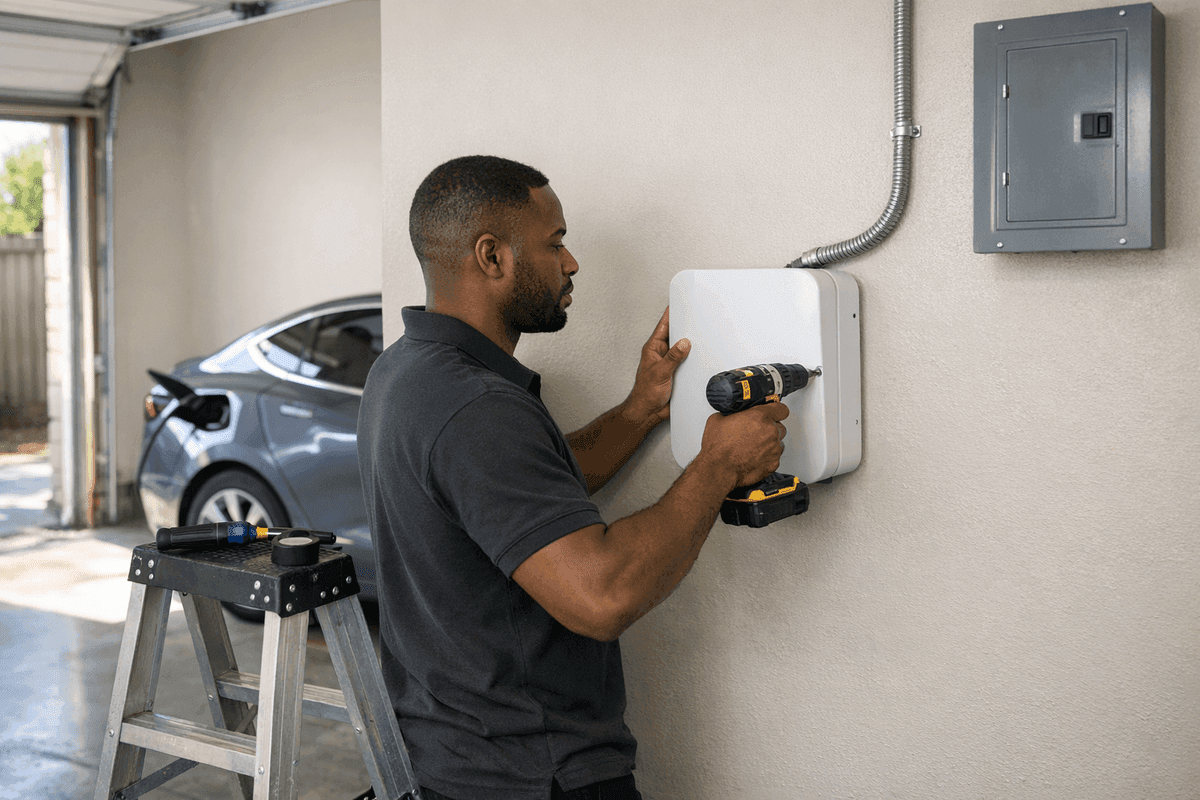
For the single-unit owner who has HOA approval to add a charger at their stall, we design the circuit from the nearest electrical distribution panel in the parking garage, run conduit along the garage ceiling to the stall, and install a metered Level 2 charger. The meter ensures the owner is billed for their charging — either through direct metering or via a smart charger with energy monitoring. We pull the Chicago Department of Buildings permit, coordinate with the building engineer on the shutdown scope, and handle the final inspection.
For building-wide programs, we work with property managers on phased installation plans that allow a growing percentage of residents to add chargers without requiring a simultaneous building service upgrade. Load-managed charging networks — where chargers communicate with each other and share available capacity — are the enabling technology for this, and we configure them as part of the installation.
Common EV Charging Challenges in West Loop
- High-rise parking garage with limited electrical service — Many West Loop residential buildings have shared parking services sized for lighting and minimal plug loads. A building load study often reveals that adding more than a handful of Level 2 chargers would overload the existing garage service. We work with building engineers on upgrade paths and load management solutions.
- HOA approval in condominium buildings — Chicago condo associations have varying policies on individually owned EV chargers in shared garages. Some buildings have blanket approval processes; others require engineering review and board votes. We provide all the technical documentation HOAs need to make an approval decision quickly.
- Metering individual chargers in shared garages — In a building where electricity for parking is a common expense, adding an EV charger requires a way to bill back the charging cost to the individual owner. This requires either a dedicated sub-meter on the charger circuit or a smart charger with energy tracking. We design both solutions.
- Loft buildings with unconventional parking — Converted Fulton Market lofts sometimes have semi-structured or surface parking with limited electrical infrastructure. These buildings may have more flexibility on circuit routing than high-rises but fewer existing electrical panels to tap.
- Builder-grade unit panels at capacity — Some West Loop condo towers have undersized unit panels (often 100 amps or less) because developers built to minimum code. Adding a dedicated 40-amp EV charger circuit to a full 100-amp panel requires load shedding or a panel upgrade. We evaluate options honestly.
Why West Loop Residents Choose E&P Electric
West Loop EV charging projects demand electrical contractors who understand both the residential and commercial sides of building electrical systems. Our West Loop work has included Fulton Market restaurant build-outs at 400A three-phase, warehouse loft conversions, and residential tower work — so we know how these buildings are wired and how to navigate building engineers and property managers.
We're experienced with load-managed EV charging networks including ChargePoint, Blink, and JuiceBox commercial systems, which are increasingly relevant as buildings plan for multi-stall installations rather than one-off chargers. We also handle individual residential smart charger installs (Tesla Wall Connector, JuiceBox, ChargePoint Home Flex) and configure all Wi-Fi, app, and scheduling features.
Our supervising electrician license means we handle all permits, including the Chicago Department of Buildings commercial permit process that applies to parking garage work in large buildings.
Get a Free Estimate Today
Serving Chicago and Chicagoland. Licensed and insured.